
The technology platforms Compositadour, Addimadour and Turbolab share a common research and analysis laboratory dedicated to composite materials and additive manufacturing.
This laboratory is equipped with a wide range of advanced characterisation tools, enabling precise and reliable testing across a broad variety of materials and components.
Precision techniques dedicated to the analysis of metals and composite materials
Sample preparation
The laboratory is equipped with the necessary tools for sample preparation:
- a cutting machine for sectioning samples (Labotom-5)
- a fume hood for cold mounting of samples
- an automatic polishing machine (LaboForce – 100)
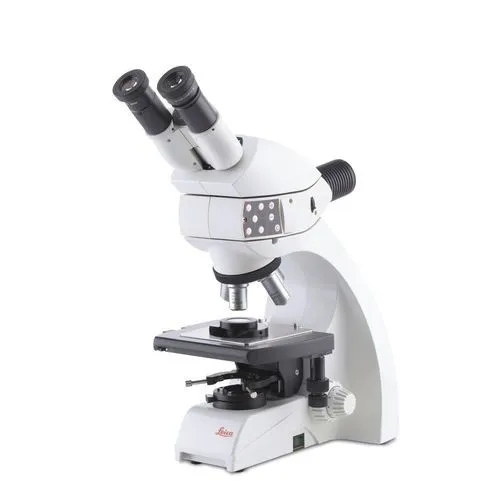
Optical Microscope – Leica DM750M with ICC50 camera
We carry out precise metallographic analyses using our LEICA DM750M microscope equipped with an ICC50 camera, ensuring detailed observation and high-quality image capture.
This service covers both metallic and composite materials, tailored to your inspection and expertise requirements.
Metallic section
Metallographic microscopy applied to metals makes it possible to observe internal microstructures following metallographic preparation (mounting, polishing, chemical etching).
It is essential for:
- Identifying metallurgical phases
- Measuring grain size
- Assessing the quality of heat treatments
- Inspecting welds
- Detecting anomalies such as decarburisation, inclusions, porosity and segregation
Composites
Microscopic analysis of composite materials enables us to characterise the integrity and quality of the fibre/matrix assembly. Our observations enable us to:
- Identify impregnation defects (voids, bubbles, dry areas)
- Analyse fibre/matrix interfaces and delamination phenomena
- Assess the quality of bonded joints and interlaminar adhesion
- Evaluate fibre alignment and reinforcement distribution
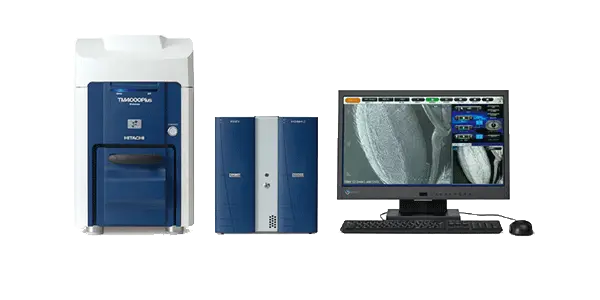
Scanning Electron Microscopy (SEM-EDX) – HITACHI TM4000 Plus II
Scanning Electron Microscopy (SEM) is one of our key technologies for metal analysis. This technique produces very high-resolution images of a sample’s surface, with magnifications reaching up to ×10,000. SEM is coupled with Energy Dispersive X-ray analysis (EDX).
SEM-EDX is used to:
- Analyse the chemical composition of metals
- Observe fracture surfaces and detect material-related defects
- Examine surfaces damaged by wear or corrosion
- Study very thin coatings
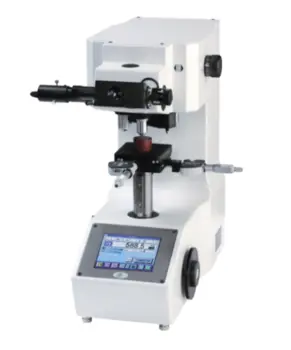
Hardness Tester – Vickers Microtech MX7
We provide precise, standardised micro Vickers hardness measurements using a Microtech MX7 microhardness tester, suitable for both industrial and laboratory applications.
Microhardness testing is an essential method for the local analysis of metal hardness. Thanks to the low load applied via a diamond indenter, the microhardness tester enables accurate characterisation of very small areas, often inaccessible using conventional hardness testing methods.
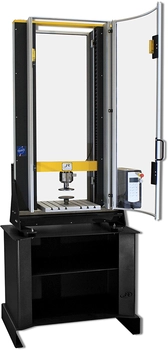
Tensile Testing Machine – Syntax 300 by 3R
Our laboratory is equipped with a Syntech 300 tensile testing machine by 3R, designed to carry out standardised mechanical testing on a wide range of metallic materials.
Thanks to its interchangeable tooling, this equipment enables several types of tests, including:
- Tensile tests: ultimate tensile strength (Rm), yield strength (Re, Rp0.2), elongation at break (A%), Young’s modulus (E)
- Compression tests: characterisation of bulk or brittle materials
- Three-point bending tests: measurement of flexural modulus and fracture behaviour
- Interlaminar shear strength (ILSS) tests: suited to composite materials or bonded assemblies
These tests are carried out in accordance with current standards (ISO, ASTM), on standard specimens or specific parts depending on your requirements.